The Pedagogy
At JIMS, STUDENTS ARE TRAINED TO BE GOAL - ORIENTED AND FOCUSED IN THEIR PERSUIT OF KNOWLEGDE.
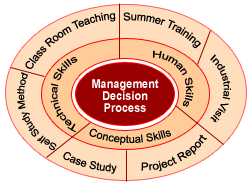
The range of teaching and learning methods used at JIMS includes lectures, case studies and presentations on strategic and contemporary issues, simulations through quizzes,assignments, contests, competitions and practical projects. A strong emphasis is laid on the use of technology in learning. Further enrichment is provided by way of guest lectures,workshops and seminars, wherein an intelligent awareness on current corporate issues and challenges is generated.
The faculty acts and works in close association with the students to help them gain a better understanding of current economic and non-economic issues and studies. Students are taught to comprehend live corporate situations while also grasping a more realistic approach to decision making.
The pedagogy lays emphasis on increasing the human skills through clear conceptual understanding of subjects, with complete exposure to industrial practices. The approach
includes the following steps:
Mr. T.S Ahluwalia
("Member-Managing Committe, FIEO")
Mr. Animesh Saxena,
Managing Director-Neetee Clothing
Mr Amit Budhiraja
(CEO, Uthopia Logistics)
Mr. Nitin Dewan
Head-International Business and Exhibitions, AVN Logistics.
Ms. Rashmi Taneja
Assistant Director, Gem and Jewellery Export Promotion Council.
Mr. Sharad
Rtd Head of Forex, Punjab National Bank
Mr. Praduman Gupta
Manager- Sales and Marketing, Lasco Shipping Company Pvt Ltd
Mr. Sumeet Saxena
Airfreight and Logistics, Kuehne Nagel
CLASSROOM LEARNING
The latest theoretical inputs are provided by the faculty of the Institute.
SELF STUDY
To keep in constant touch with the changing business environment, the future managers are required to gather information from newspapers, magazines, journals,reference books and internet. This is a part of the rigorous curriculum.
CASE STUDY METHOD
The case study method serves a dual purpose of understanding a real life situation and developing analytical skills.
PROJECT REPORTS
As an integral part of the curriculum, students are required to work on a research project on a topic of their interest or specialization. This is an excellent opportunity for students to have close interaction with the industry-experts who often give them live projects to work on. On completion of their projects, the students are required to make presentation of their reports before the industry representatives, faculty members and students.
SUMMER INTERNSHIP
The students are required to undergo summer internship for a period of six to eight weeks with reputed companies. This enables them to understand theoretical concepts learned at the Institute in a real-life corporate context. While working on live and time-bound projects, they gain first-hand experience of the corporate culture.The process helps them develop professional attitude, sense of responsibility, analytical ability and leadership qualities. It also helps the industry in assessing the students performance and potential,on the basis of which pre-placement offers are often made.
SECTORAL SPECIALIZATION
The students are required to identify the high growth sectors and make presentations in sunrise areas covering :
- Overview of the sector
- Competitive environment.
- Analysis of growth prospects
- Recommendations for the future
PERFORMANCE EVALUATION
Performance of the students is evaluated, regularly, on the basis of the following :
- Classroom participations
- Assignments
- Case - Studies
- Project Reports
- Presentations
- Mid - Term Tests
- Trimester-end Final Examinations
STUDENT CENTRIC LEARNING
Students initiate a number of activities through formation of academic clubs (Marketing, Finance, Human Resource and Information Technology), cultural club and sports club. They organize and conduct research and make presentations in the form of following activities:
- Environmental Scanning
- Strategic issues workshops
- Industrial research projects
- Corporate Checkmate -A Quarterly Lecture Series
- Annual Seminars
- Verve - Annual Inter-College cultural event
- Annual Sports Week
- Tarkash - The Entrepreneurship Cell
SELECTION CRITERIA
- Graduate in any discipline (fulfilling criteria) and from any part of the country are welcome to apply for PGDM programme.
- Admission is purely on the basis of merit and past excellence is well recognized.
- Applicants to various programmes have to pass through a three phase system of screening, which includes a Written Test (CAT or MAT), Group Discussion and Final Interview.
TEACHING METHODOLOGY & LEARNING PROCESS
Getting geared up for the highly complex and challenging business environment, calls for a method of learning that helps students comprehend the intricacies of the subject. To make the learning process easier and more interesting, the institute adopts various teaching methods and tools. An extensive use of teaching aids like LCD, overhead Projectors, slide projectors and video, is made by teachers and students alike to encourage a better understanding of the corporate concepts.
MENTORING
The Institute aims at creating a homely atmosphere for all its students, even if they are staying away from their families. This is the reason why there is the concept of "mentoring" at the Institute. Under this concept, each student is allotted a "Mentor"(a faculty member of JIMS) who helps him not only academically but also emotionally regarding any problem that he may face in any walk of life.
SHADOWING
'There can be no better friend and advisor than someone who has just done what we will be doing shortly'. This is the reason the Institute has the unique concept of "shadowing" wherein each student of first year is attached to a second year student. The first year students discuss and learn from the first-hand experience of their immediate seniors. This exercise not only helps during placements but also in the day-to-day academic and other cocurricular activities.
WORKING IN GROUPS
Right from the time a child is born, he coordinates with various people to be able to fulfill his needs. Likewise, even in a business situation, one needs to collaborate and work in tandem with marketing, finance, human resource, technology and operations departments to be able to attain the business goals and objectives.At JIMS, students are taught this right from day one by encouraging them to work in well-balanced groups where each member brings his unique ideas and propositions to the discussion table, ensuring the highest quality of work from the team.
ACADEMIC COLLABORATION
JIMS strongly believes in "learning from others". This philosophy is at the heart of our new endeavor - 'Academic Collaboration'. It is in process with renowned Business Schools within the country and abroad. This will help the Institute to adopt the best practices that are being followed in other premier global Institutions.
Social sensitivity Projects
Students are attached to NGO’s, community projects and put their managerial skills in enhancing their reach or establish their business models